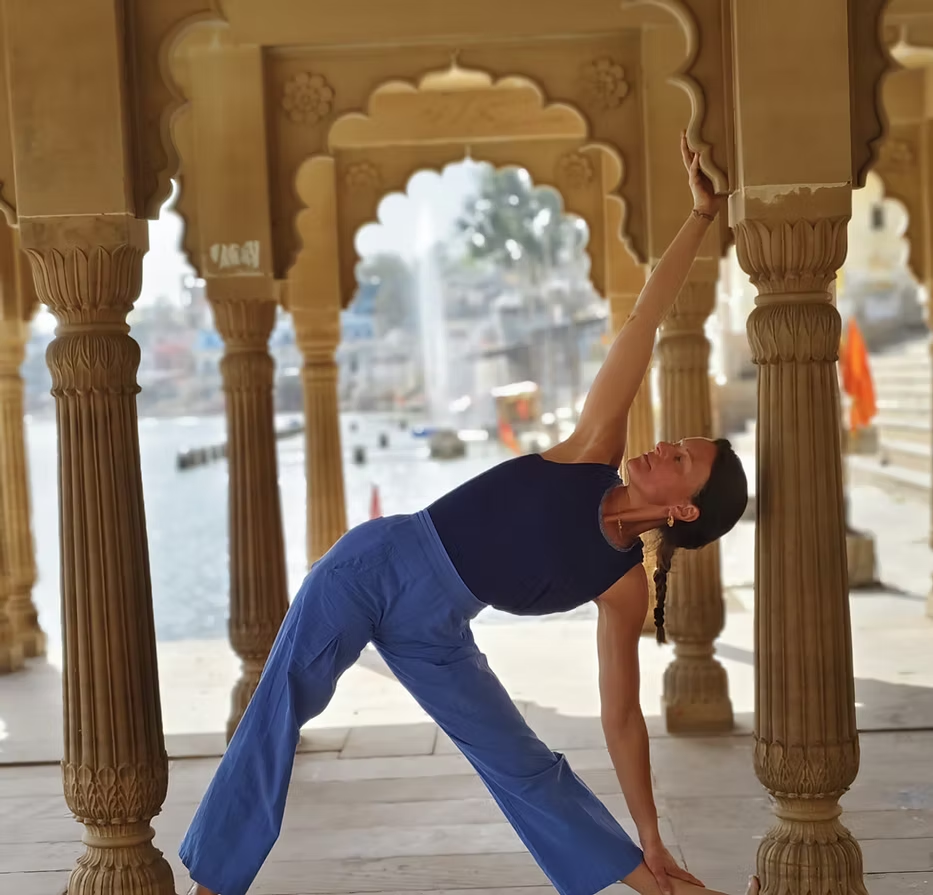
I got the idea for this article after seeing an Instagram post by Manon @drishti_yoga_17.
When we see an ‘easy’ or ‘perfect’ yoga session, we don’t realise the real journey that lies behind it. Which can sometimes be difficult.
Her story is proof that results come if you’re consistent, no matter where you start.
Yoga isn’t just for people with ‘perfect bodies’.
On the contrary, practising yoga is invaluable in difficult situations and can help us get through certain challenges.
Manon, I was really surprised to hear about your background. You dreamt of becoming a dancer, like most girls, but it wasn’t possible?
On the one hand, I’ve always been tall and very slim – a body I didn’t know what to do with. I was constantly bumping into things everywhere! The various teachers would systematically put me at the back of the class. Their comments were discouraging. In the 1980s, empathy and kindness weren’t the order of the day, especially in ballet classes! On the other hand, the recurring back pain, which was getting worse and worse, forced me to give up partway through the year. I can still remember the moment when, plucking up my courage on a street in the lower part of Puteaux, I asked my mum if I could stop going. How could I possibly carry on with such pain? Whilst being snapped at and mocked for my clumsiness and obvious lack of grace?!!
How did yoga come into your life?
I got into it through the back door in Goa in 1993. A renowned Ashtanga teacher – a nice chap, but one who failed to light the fire! A class taught in English, which at the time was a bit of a stumbling block. And at a level above my own.
I’m naturally stiff. I can still picture myself in Paschimottanasana. Unable to reach my feet. With the teacher behind me pressing down on my back to force me down onto my legs… A rather rough way to start! I’d tried again, full of good intentions, but discouraged by my inability to adapt. I was with two good friends who practised yoga with him. I admired them for their calm, almost detached demeanour, whereas I was so hyper and spontaneous. It wasn’t the right time! It wasn’t until early 2000 that I finally walked into a class with one of those two friends. She had become, in the meantime, an Iyengar teacher… it was a revelation! Yoga was welcoming me with open arms; the path to reconciliation lay before me!
How did you learn to tell the difference between the pain of a challenge and the pain of an injury?
It all began with my teacher’s instructions, as I learnt to tune into my bodily sensations. It took me years before I could place my hands on the floor without arching my lower back in Uttanasana. (Oh, how that really stung my hamstrings!
I’d say the first 15 years were devoted to just that: creating openings where there were blockages. Moving what had stopped moving, and, above all, getting to know myself!
Then, in 2020, came the pandemic. The widespread availability of online classes, access to brilliant teachers from all over the world, and more advanced practices.
I went from one class to the next. Exhilarated by these new possibilities. Regaining control (and a bit of revenge, too!) over this body and its many limits, which I was constantly pushing. Blinded by the pleasure that, let’s face it, flatters the ego, I became a little disconnected from my bodily sensations. I practised every day, like an ascetic. First injury: the infamous “yogi butt”*. Time to slow down again. Adapt my practice, and listen – turning my attention to my sensations and no longer turning away from them!
I continued my training – in anatomy, postural analysis and yoga therapy. To avoid pitfalls with my students, but above all to understand. To read bodies, including my own.
The pangs of passing time, the body—this living matter that evolves. The scoliosis that has returned, and this back whose balance was, after all, precarious. It had left me in peace all these years; now I must come to terms with it once more.
I have never had a body that was ready, a yoga teacher’s body. I must prepare this earthly vessel and pamper it wisely so that it opens up.
To conclude this answer, I would say that my personal practice is the best guide.
If it pulls or stings in the middle of a muscle. Or if it shoots or pinches in a joint or at the end of a muscle. It’s not the same thing at all. The body speaks to us – let’s listen to it!
Feeling pain after a session is neither normal nor harmless. Iyengar yoga offers so many adaptations of postures and props that pain is avoidable and the asana achievable.
It’s all about using the posture to connect with your body, rather than forcing your body into the posture. That makes all the difference. Live fully within your body.
Many people think that advanced yoga is all about flexibility. For you, coming from a ‘fragile’ body, what was the real challenge: strength, coordination, confidence, or something else?
The advanced level is often interpreted as the ability to perform complex asanas worthy of contortionists. But might it not be more about practising with the yamas and niyamas as our guides? Breathing, mastering the art of feeling alive? Simply experiencing a vibrant sense of well-being?
A strong and supple muscle is always a matter of balance. As Prashant Iyengar says, a posture always has something to offer us, whether it’s a variation or the full posture. Yoga welcomes us exactly where we are. Savasana can be an advanced practice on some days, lying still, listening to one’s breath. And on other days, Hanumanasana will be the advanced practice, representing that great step towards our universe!!!
If you could go back in time and say something to the child you once were, knowing the yoga teacher you’ve become. What would you say to them?
Don’t identify with your ailments; don’t define yourself by your pain. Love your body, and it will love you back! Nothing is set in stone; life – and yoga too – is a realm of possibilities!
Nowadays, when you teach students who complain that they aren’t ‘flexible enough’. What story from your own life do you want to share with them?
I teach older adults and, generally speaking, my students are older than me. Our daily rhythms have become disrupted; we no longer listen to one another. I help them to do so – through the teaching materials, techniques and adjustments I provide. I share my own story and recount anecdotes from my journey, which highlights the authenticity of the path I’ve taken. It’s about understanding, not judgement. And certainly not a moral lecture – when I encourage them not to cling to their feet in paschimottanasana!
If you had to summarise the main message of your journey for someone who thinks it’s ‘too late’ or ‘too difficult’ to take up yoga. What would it be?
Without rushing or judging, encourage them to let go of limiting beliefs. Although everyone’s story is different, all too often the negativity in a statement acts as a hindrance. A barrier to one’s own fulfilment. I’d like to quote BKS Iyengar: “Yoga is the art of breaking down boundaries. Do not cut yourself off from the Infinite with ideas that are too narrow. Always leave open the possibility of saying, ‘I’ll try. I’ll see.’ Create within the infinite. Do not limit yourselves.”
*”yoga butt injury”: a fairly common injury amongst yoga practitioners. Often linked to tendinopathy or irritation of the hamstrings at their point of attachment beneath the buttocks. This can occur, in particular, as a result of repeated stretching and certain poses.
Manon teaches in Royan, Breuillet and Vaux-sur-Mer. For more information about her classes